American Lock Washers Guide: Types, Sizes, Materials and Applications
American Lock Washers Guide: Types, Sizes, Materials and Applications
American lock washers are widely used fastening components designed to prevent loosening caused by vibration, dynamic loads, and thermal expansion. Although often overlooked, lock washers play a crucial role in maintaining joint integrity in mechanical and structural assemblies. This guide explains their standards, types, materials, and practical applications to help engineers and buyers make informed decisions.
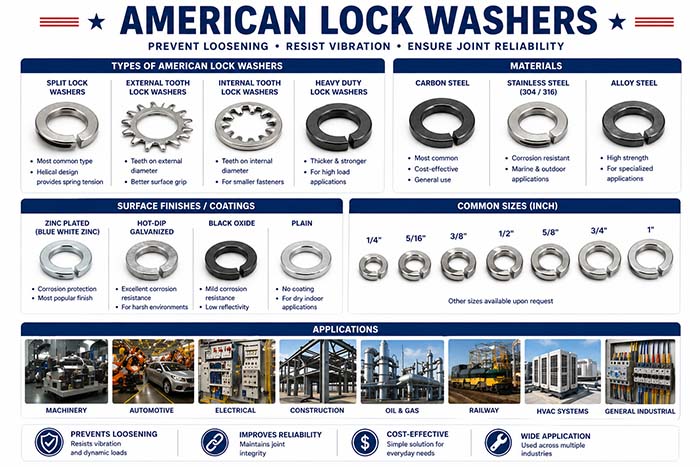
What Are American Lock Washers?
American lock washers, also known as spring lock washers or split lock washers, are specially designed washers that apply tension and friction to prevent fasteners from loosening. They are typically installed under a nut or bolt head and work by exerting a spring force while biting into the mating surfaces.
At IIIBEAR Fastener, we frequently advise customers that while lock washers are simple, choosing the correct type is essential for ensuring performance in real-world applications.
Key Standard for American Lock Washers
The primary standard governing inch-series lock washers is ASME B18.21.1. This standard defines dimensions, tolerances, and general requirements for split lock washers used in the United States.
This standard ensures compatibility with common fasteners such as hex bolts, hex nuts, and threaded rods using unified inch threads.
Types of American Lock Washers
There are several types of lock washers, each designed for specific applications:
- Split Lock Washers – The most common type, featuring a helical shape with a split end
- External Tooth Lock Washers – Teeth on the outer edge for better surface grip
- Internal Tooth Lock Washers – Teeth on the inner edge, often used for smaller fasteners
- Heavy Duty Lock Washers – Thicker and stronger versions for industrial applications
Among these, split lock washers remain the most widely used due to their simplicity and cost efficiency.
American Lock Washers Sizes and Dimensions
Lock washers are sized according to the bolt or screw they are designed to fit. Common inch sizes include:
- 1/4"
- 5/16"
- 3/8"
- 1/2"
- 5/8"
- 3/4"
- 1"
Each size has defined inner diameter (ID), outer diameter (OD), and thickness. Proper sizing ensures effective locking performance and compatibility with fasteners.
Materials Used in American Lock Washers
The material of a lock washer determines its strength, elasticity, and corrosion resistance.
- Carbon Steel – Most common, cost-effective, suitable for general use
- Stainless Steel (304 / 316) – Provides excellent corrosion resistance
- Alloy Steel – Used in higher strength or specialized applications
Stainless steel lock washers are commonly used in marine, chemical, and outdoor environments where corrosion resistance is essential.
Surface Finishes and Coatings
Surface treatments improve durability and corrosion resistance. Common finishes include:
- Zinc Plated (Blue White Zinc)
- Black Oxide
- Hot-Dip Galvanized (HDG)
Zinc plating is the most popular option due to its balance between performance and cost, making it suitable for most industrial applications.
American Lock Washers in Fastening Systems
American lock washers are typically used in conjunction with bolts and nuts to enhance joint reliability. They are especially useful in applications where vibration is present.
However, it is important to note that lock washers are not recommended for high-strength structural applications. In such cases, hardened flat washers such as ASTM F436 are preferred.
Applications of American Lock Washers
Lock washers are widely used across various industries:
- Machinery and equipment assembly
- Automotive manufacturing
- Electrical installations
- General industrial fastening
They are particularly effective in preventing loosening in light to medium-duty applications where vibration may occur.
Why Choose American Lock Washers for Vibration Resistance
American lock washers are a cost-effective solution for improving resistance to loosening caused by vibration. Their design allows them to maintain tension and increase friction between the fastener and the surface.
For applications requiring higher reliability, alternative locking solutions such as prevailing torque nuts or wedge lock washers may be considered.
Selection Guide for American Lock Washers
When selecting lock washers, consider the following factors:
- Fastener size and compatibility
- Load and vibration conditions
- Environmental exposure
- Material and coating requirements
Choosing the right washer ensures optimal performance and prevents premature failure.
Conclusion
American lock washers are simple yet effective components that enhance the reliability of fastening systems. By understanding their standards, types, materials, and applications, buyers and engineers can select the right solution for their needs.
Whether for general industrial use or specific applications, lock washers remain an essential part of modern fastening technology.

Related products: Washers

